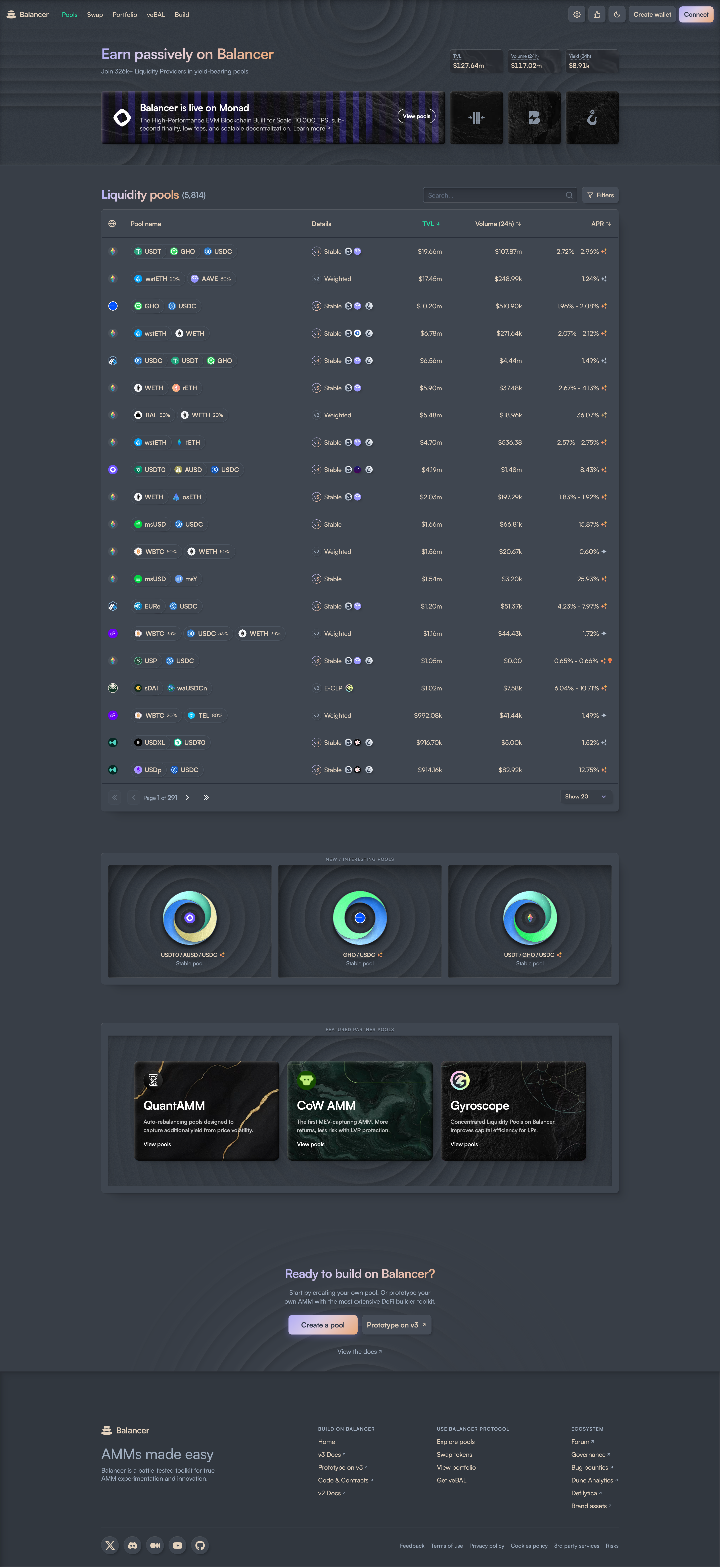
Decentralized finance (DeFi) has transformed how people trade and provide liquidity by replacing centralized intermediaries with permissionless protocols and automated market makers (AMMs). Among AMMs, Balancer stands out for its flexible multi-asset pools, customizable weights, and advanced routing mechanisms. A “Balancer swap” lets traders exchange one token for another using liquidity pooled by users, while benefiting from features designed to reduce slippage, improve capital efficiency, and enable novel liquidity strategies.
This article explains what a Balancer swap is, how Balancer pools work, the mechanics behind swaps (including pricing and fees), the advantages and trade-offs of using Balancer, and practical considerations for traders and liquidity providers. We’ll conclude with a look at advanced features such as multi-hop routing, external integrations, and future directions.
A Balancer swap is a token exchange executed through the Balancer protocol. Instead of matching buyers and sellers, Balancer routes the trade against one or more liquidity pools that hold the tokens involved. These pools are smart contracts that maintain reserves of multiple tokens and an automatic pricing formula. When a trader submits a swap, the pool adjusts its reserves according to the formula and returns the output token to the trader, charging a protocol and/or pool fee.
Unlike simple two-token AMMs like Uniswap v2, Balancer supports pools containing multiple tokens (up to eight) with configurable weightings for each asset. This flexibility allows pools to be customized to reflect desired exposure (for example, an index-like pool or a liquidity pool with uneven token weights), and it enables route optimization where a single swap might traverse multiple pools or tokens to achieve better prices.
Balancer supports several pool types and features designed for different use cases:
* Weighted pools: The core pool type where each token has a weight (e.g., 50/50, 80/20, or 33/33/34). Weights determine how prices move in response to trades and how fees and impermanent loss are experienced. Commonly used for pairs and multi-asset pools.
* Stable pools: Optimized for assets with tight price peg relationships (e.g., different USD stablecoins or wrapped versions of the same asset). Stable pools use a different invariant curve to allow much lower slippage for large trades between closely pegged assets.
* Meta-stable or hybrid pools: Variants that attempt to combine features for both volatility and stability.
* Smart pools / managed pools: Pools where certain parameters (weights, fees, etc.) can change according to governance or pre-set strategies.
* Liquidity Bootstrapping Pools (LBPs): Designed to help projects sell tokens while discouraging bots and front-running, often using dynamic weight adjustments.
Each pool is a smart contract that enforces invariants and manages deposits, withdrawals, swaps, and fee accounting. Liquidity providers (LPs) deposit tokens into pools and receive pool tokens (Balancer Pool Tokens — BPT) representing their share. LPs earn a portion of swap fees proportional to their share of the pool.
At the heart of Balancer’s swap logic lies an invariant that links token balances and weights to prices. For a standard weighted pool, the invariant is a generalized constant product function. For a pool with n tokens with balances Bi and weights wi, the invariant can be expressed as the product over i of Bi^(wi) — this ensures the pool maintains a certain relationship as balances change. When a swap occurs (for example, token A for token B), the pool’s token A balance increases and token B balance decreases, and the formula computes the exact output amount that maintains the invariant while accounting for fees.
Key consequences of this design:
1.Price impact depends on token weights: A token with a lower weight will move more in price for a given trade size than one with a higher weight.
2.Multi-token pools: Because the invariant is generalized, pools with more than two tokens still normalize trades among all constituents appropriately.
3.Slippage and trade size: Larger trades relative to pool size push prices farther from the mid-market rate — so deeper pools or multi-pool routing help reduce slippage.
Stable pools use a different curve (similar in spirit to Curve’s stable-swap invariant) to dramatically lower slippage between tightly pegged tokens. This makes them ideal for swapping between stablecoins or close assets, often at a lower fee than weighted pools.
Swap fees on Balancer typically consist of:
* Pool fees: Charged to traders by the pool, distributed to LPs. Pool creators choose the fee percentage (within protocol constraints) and can set different fees for different pools based on expected activity and risk.
* Protocol fees or governance split: A portion of fees may go to Balancer’s treasury or governance depending on protocol parameters, though specifics evolve.
Fee structure matters for both traders and LPs. For traders, higher fees increase transaction cost but may reflect pools optimized for a particular trade (e.g., low-slippage stable pools may have lower fees). For LPs, fees are the main revenue stream to compensate for impermanent loss — price divergence between pool assets that causes paper losses relative to simply holding the tokens.
Providing liquidity on Balancer exposes LPs to impermanent loss, where the value of their LP share may be less than holding the underlying assets if relative prices diverge. The degree of impermanent loss depends on weightings and volatility:
* More evenly weighted pools (e.g., 50/50) suffer more symmetric impermanent loss for equal price movements.
* Unequal weights (e.g., 80/20) skew exposure, potentially reducing impermanent loss for one asset while concentrating it on another.
* Multi-asset pools can diversify impermanent loss across several tokens, sometimes reducing net impermanent loss compared to repeated pairwise exposure.
LPs mitigate risk by carefully selecting weights, choosing stable pools for pegged assets, employing external hedges, or using strategies that take advantage of fees and arbitrage to offset losses.
One of Balancer’s strengths is its ability to optimize swap routes. When a user wants to trade token X for token Y, Balancer’s on-chain or off-chain routing logic considers multiple pools and hop sequences to find the path that gives the best output after fees and slippage. For example, swapping token X to Y may be cheaper by routing X -> WETH -> Y across two pools rather than a direct X-Y pool with low liquidity.
Key points about routing:
*Multi-hop trades: Balancer can execute swaps that pass through intermediary tokens automatically in a single transaction.
*Aggregation and batch swaps: The protocol supports batch operations where multiple pools and swap steps occur atomically, reducing front-running and giving exact trade execution guarantees.
*Off-chain tooling: Wallets and front-ends often query Balancer’s subgraph or routing services to estimate best paths before submitting transactions.
Front-ends also display expected slippage, price impact, and minimum received amounts to help users choose routes and tolerances.
Balancer shares similarities with protocols like Uniswap and Curve but differentiates itself in several ways:
1.Multi-asset pools and configurable weights: Balancer’s most distinctive feature, enabling index-like pools and advanced liquidity constructs.
2.Customizable fees: Pool creators choose fees that reflect risk and expected volume.
3.Advanced routing: Balancer’s routing can exploit its multi-pool architecture for better pricing.
4.Stable pool optimization: Competing with Curve in efficient stablecoin swaps, but within the Balancer ecosystem and tooling.
Trade-offs include increased complexity for LPs managing multi-asset exposure and potentially higher gas costs for complex, multi-hop transactions (though Balancer’s batching and integration with gas-optimized routers can mitigate this).
If you’re trading on Balancer, keep these practical tips in mind:
1.Check pool depth and weight: Larger pools generally mean lower slippage; pools with favorable weights relative to your trade will impact price differently.
2.Use stable pools for pegged assets: If swapping between stablecoins or tightly correlated assets, prefer stable pools to minimize slippage and fees.
3.Review fees and minimum received: Front-ends will show expected fees and slippage. Set a reasonable slippage tolerance to avoid failed transactions or frontrunning.
4.Consider routing: Let Balancer or integrated aggregators find the best route. Sometimes an indirect path yields a better net rate.
5.Watch for gas: Complex multi-hop or batch swaps can cost more gas. During periods of high network congestion, evaluate whether the price improvement is worth the gas cost.
6.Security and audits: Use pools with known contracts, verified source code, and established liquidity to reduce smart contract risk.
To keep you informed about the progress of your delivery, we provide shipment tracking for most orders. Once your order is shipped, you will receive a confirmation email with a tracking number and instructions on how to track your package. This allows you to monitor the status of your shipment and estimate its arrival.
Balancer continues to evolve with features that expand swap functionality:
1.Vault architecture: Balancer’s Vault (introduced in v2) centralizes token transfers, reduces gas, and enables more efficient management of pool assets and permissions. This architecture also facilitates complex batch swaps and better composability.
2.Protocol integrations: Balancer integrates with wallets, aggregators, and other DeFi projects to provide routing and liquidity opportunities.
3.External composability: Developers can build on top of Balancer to create automated strategies, index funds, or leveraged products, benefiting from Balancer’s multi-asset and weight configuration.
4.Governance and tokenomics: BAL token holders participate in governance and can influence fee settings, emissions, and upgrades, aligning incentives across users and LPs.
Despite its strengths, Balancer has limitations and risks:
1.Smart contract risk: As with all DeFi protocols, bugs and exploits remain a possibility. Use audited pools and avoid unknown contracts.
2.Impermanent loss: LPs can see temporary or permanent losses relative to simply holding assets, especially in volatile markets.
3.Complexity for casual users: Multi-asset pools and configurable weights add choices and complexity that may confuse inexperienced users.
4.Market fragmentation: Liquidity can be spread across many customized pools, potentially fragmenting depth and increasing the need for routing logic.
A Balancer swap is a flexible, powerful tool in the DeFi trader’s toolkit. By leveraging configurable multi-asset pools, varied fee structures, and smart routing, Balancer enables efficient swaps across a wide range of token pairs and market conditions. Traders benefit from better routing and stable-pool efficiencies for pegged assets, while liquidity providers can design pools tailored to their desired exposure and fee income. Yet, these opportunities come with the familiar DeFi trade-offs: smart contract risk, impermanent loss, and the need to understand pool mechanics.
Whether you’re swapping stablecoins with minimal slippage, routing complex multi-hop trades, or designing an index-like liquidity pool as an LP, Balancer’s architecture provides flexible primitives for modern decentralized markets. As the protocol and ecosystem mature, expect continued improvements in routing efficiency, gas optimization, and composability that will make Balancer swaps even more attractive for traders and liquidity providers alike.

AI Website Creator